
How does, and will, a warming world effect the land, sea and wildlife of Antarctica? How does Antarctica affect us?


West Antarctic is one of the fastest warming areas on Earth: three times faster than other areas of the planet. Within the last 5 years scientists even recorded its warmest day ever at 17.5°C; that is as warm as the British summer!
This is worrying because, although no people live here permanently, global warming here will affect human populations wherever you live in the world.
But someone said ice is expanding in Antarctica? Surely it can’t be warming?
Although you may think that global warming would cause ice to melt in Antarctica, the picture isn’t that simple. In the West yes, ice is melting at a growing rate and this does cause changes. However, some scientists claim that ice is accumulating (growing) in East Antarctica, perhaps even at a rate than is faster than melting!
The major factor to consider here, is the type of ice: is it sea ice or land ice? Sea ice is just frozen sea, whilst land ice accumulates after snowfall on land. When sea-ice melts, the water level isn’t affected because the ice was part of the water anyway, and it displaced part of the sea as it floated on top. In contrast, when land ice melts and drains into the sea, the water is relocating from a land storage to an ocean storage, causing the ocean level to rise.
This shows just how complex the effects of global warming could be.
Ocean Acidification

Greenhouse gases exist in the atmosphere (air) and in our oceans. As more of these gases are pumped into the air, more is being absorbed into the sea too. This is a big problem in the Southern Ocean (near Antarctica), because the gases are absorbed more easily in the cold waters here. This makes the ocean more acidic and affects the balance of things called ‘carbonate ions’ in seawater (this bit gets a little sciencey but stick with it!). This means that animals such as oysters and other small creatures cannot build their shells, or build them at a slower rate, because they rely on these ‘carbonate ions’ to build calcium carbonate shells. Many of the organisms that are affected are producers, meaning that almost all larger ocean creatures (such as whales and fish and seals) rely on them for survival. The more these gases are absorbed by the ocean (as is predicted in the future), the more food chains will be affected and it may cause a reduction in Antarctic wildlife.
Albedo- It’s all about reflection
Have you ever noticed that when you leave your black phone out in the sunshine for a few minutes, it gets very warm? Similarly, when you wear black clothing like a black top, jumper or wetsuit on a sunny beach day, you get very hot. This is because energy, which comes from the sun, is absorbed really well by dark colours like black. In contrast, if you were to wear a white t-shirt in the sun, you would warm up much slower.
The Earth acts in a similar way. Ice, which is white, reflects lots of the sun’s energy, meaning that the air around it is cooler. In contrast, the dark muddy ground and blue ocean absorb more of the sun’s energy because they are darker colours. This is called the albedo effect.
But… (and this is a big, worrying but) if more ice melts and is replaced by more dark ocean and mud surfaces, more of the sun’s energy will be absorbed and less reflected. This basically means that the Earth’s surface will get much warmer, and this leads to more melting of ice, which leads to more absorption of energy which leads to more warming and so on, in a cycle. Once stuck in this runaway cycle, it is very, very difficult to stop and this will make global warming irreversible.
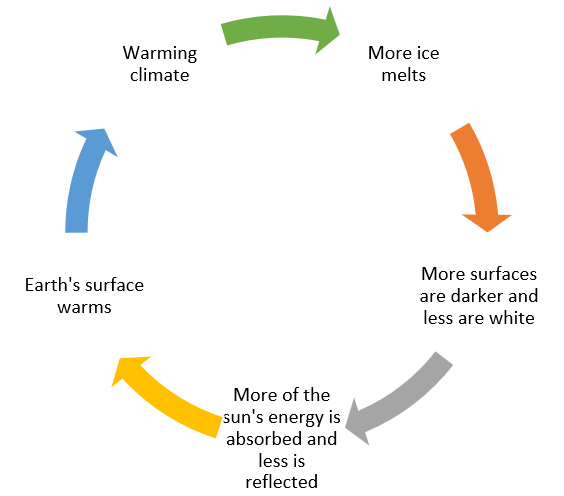
Overall, the albedo effect is causing the Earth to warm up (because of the science of reflection and absorption of energy).
Animals
Much Antarctic wildlife (on land and ocean) is unique and special, such as penguins and whales, but all will be affected due to rising temperatures.


- Penguins
Different species will be affected differently as they eat different fish and live in different ways.
Adélie penguins have shrunk in number recently due to reductions in krill and fish populations (which they eat) as well as changing weather conditions.
Emperor penguins are also at risk, perhaps even facing extinction as soon as 2100 (perhaps in your lifetime!) because the sea ice where they look after their eggs and chicks has declined and will continue to decrease.
Find out more here: https://thecvf.org/climate-change-penguins/
- Krill
Whilst krill might not be the prettiest of species, they are essential as food for many larger animals: if ocean ecosystem was a car they would be the petrol! These tiny creatures look a bit like shrimp and many live in Antarctic waters.
They are in trouble because they often feed on algae (green slimy stuff), which grows beneath sea ice, which is shrinking in many areas. In an ocean which is becoming more acidic, it is also hard for them to reproduce successfully.
How does this affect people?
Even though it seems a world away, we are all connected to Antarctica and its climate, ice extent, ocean and wildlife.
- Changes in the Antarctic water will affect oceans nearer to our homes, as the ocean is constantly in motion. Acidic waters in the South will therefore slowly move north and acidify our oceans too, affecting wildlife here.
- Melting ice in Antarctica will lead to sea-level rise globally, flooding low-lying areas in our own countries.
- The albedo effect will create runaway warming which we will be helpless to stop. These rising temperatures will affect us.
- Fewer David Attenborough documentaries about penguins!!

But it’s not all bad news! There are so many things we (including YOU) can do to look after Antarctica and its wildlife before it gets to the stage where its too late.
References (where I got my facts from)
- West Antarctica Melting: Sheperd, A., Wingham, D. & Rignot, E., 2004. Warm ocean is eroding West Antarctic Ice Sheet. Geophysical Research Letters, 31(23)
- East Antarctica Mass Growth: Zwally, J. H. et al., 2015. Mass gains of the Antarctic ice sheet exceed losses. Journal of Glaciology, 61(230), pp. 1019-1036
- Antarctic and Southern Ocean Coalition: https://www.asoc.org/advocacy/climate-change-and-the-antarctic & https://www.asoc.org/advocacy/climate-change-and-the-antarctic/ocean-acidification
- Greenpeace: https://www.greenpeace.org.uk/what-climate-change-means-for-the-antarctic/
- Discover Antarctica: https://discoveringantarctica.org.uk/challenges/sustainability/impacts-of-climate-change/
- British Antarctic Survey Penguins: https://www.bas.ac.uk/wp-content/uploads/2015/04/penguins_2008.pdf
- Surpriya on Risks to Emperor Penguins: https://www.sciencemag.org/news/2017/07/emperor-penguins-may-disappear-end-century
- Krill Decline: Atkinson, A., Siegel, V., Pakhomov, E. & Rothery, P., 2004. Long-term decline in krill stock and increase in salps within the Southern Ocean. Nature, 432(7013), pp. 100-103
- BBC Antarctica Diagram: http://news.bbc.co.uk/1/hi/sci/tech/4767296.stm West Antarctica Melting: Sheperd, A., Wingham, D. & Rignot, E., 2004. Warm ocean is eroding West Antarctic Ice Sheet. Geophysical Research Letters, 31(23)
- East Antarctica Mass Growth: Zwally, J. H. et al., 2015. Mass gains of the Antarctic ice sheet exceed losses. Journal of Glaciology, 61(230), pp. 1019-1036
- Antarctic and Southern Ocean Coalition: https://www.asoc.org/advocacy/climate-change-and-the-antarctic & https://www.asoc.org/advocacy/climate-change-and-the-antarctic/ocean-acidification
- Greenpeace: https://www.greenpeace.org.uk/what-climate-change-means-for-the-antarctic/
- Discover Antarctica: https://discoveringantarctica.org.uk/challenges/sustainability/impacts-of-climate-change/
- British Antarctic Survey Penguins: https://www.bas.ac.uk/wp-content/uploads/2015/04/penguins_2008.pdf
- Surpriya on Risks to Emperor Penguins: https://www.sciencemag.org/news/2017/07/emperor-penguins-may-disappear-end-century
- Krill Decline: Atkinson, A., Siegel, V., Pakhomov, E. & Rothery, P., 2004. Long-term decline in krill stock and increase in salps within the Southern Ocean. Nature, 432(7013), pp. 100-103
- BBC Antarctica Diagram:
 A Climate Change GUIDE
1 thought on “How does Climate Change affect Antarctica?”